In any given society, there will always be people who develop deep regret from committing acts of service for their government regardless of whether or not they’re socially encouraged as something to evoke pride in. We often hear stories about war veterans or anyone who worked a government job that required soliciting violence, struggling with PTSD for the rest of their lives. Occasionally, having a respected public image is enough to keep one content with the actions they have produced to get to where they are now. Still, on the other hand, it could also be temporary mental gymnastics.
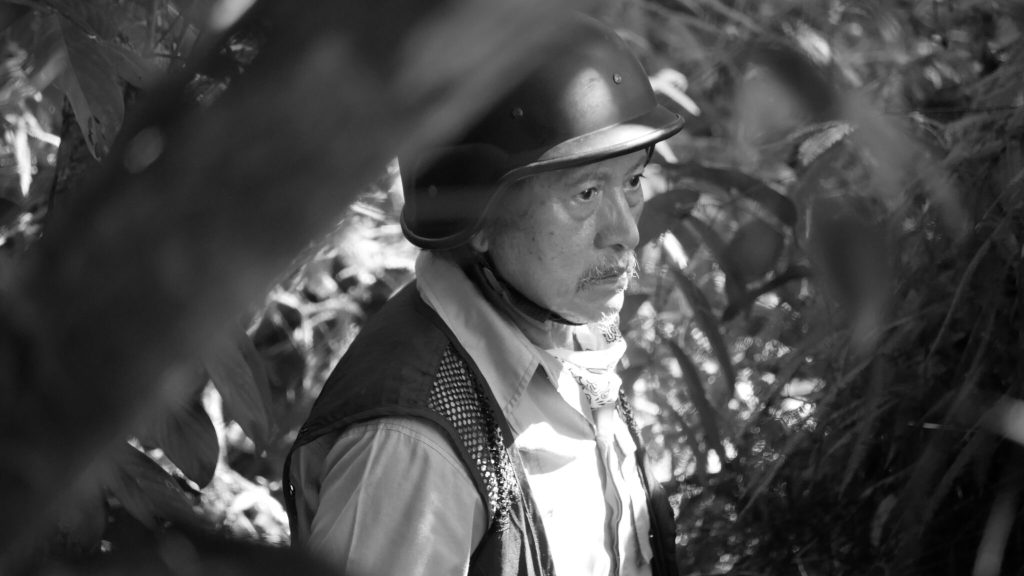
Hilarion Zabala (Ronnie Lazaro) is a man who, from the looks of it, has never actually thought about the things he’s done to others. He’s never thought about the innocent people he put in danger during his time in the military, he’s never thought about his assigned assassinations and he barely even thinks about what his personal desires have done to shape his children over the years. That is until he begins developing phantosmia: the condition of smelling something that isn’t actually there. This situation brings back vivid memories of his past military services which had ultimately made him a renowned soldier in the Philippines.
With this set-up, director Lav Diaz tells a familiar story about an elderly man wanting to redeem himself out of distaste for the life he’d lived. Think Akira Kurosawa’s “Ikiru” (1952) butting heads with Martin Scorsese’s “Taxi Driver” (1976) but executed in a methodical and vérité manner that’s trademarked to Diaz’s usual mode of lengthy storytelling — 4 hours and 6 minutes this time to be precise.
The end product is a virtually unembellished look at processing failure and wanting to promptly overthrow it by trying to understand one’s current environment for a change. It’s about finally picking out the elements that morally do not sit well with it rather than abiding by its accepted flow of social norms or assigned duties. It’s a viewpoint that sides with rebellion when justifiable and for the betterment of victims who suffer under corrupt government regulation.
While “Phantosmia” is a tale of redemption, it is not a clean-cut one as is real life. There’s a slight cynicism to the movie, where the main character’s solutions, due to the way he was raised, ultimately result in violence even in the present at his old age. It embodies the saying, “Old habits die hard.” Yet, by the end, Zabala commits the kind of violence that at least tries to compromise with what little good it can lead to in a world where people will always have the power to control and maneuver via brutality.
Brian Hu (left) and Hideki Takeuchi (right) Photo courtesy of Allan Regala
At the turn of the millennium, Lee Ann Kim, the founder of the Pacific Arts Movement, had the idea to bring an Asian film festival to San Diego. After onboarding artistic director Brian Hu, the two would program a festival full of creative and innovative films that wouldn’t have been shown before. Kim and Hu built the festival on the idea that “If you won’t tell our stories, we will.” Fast forward two and a half decades and they are celebrating not only the 25th anniversary of the San Diego Asian Film Festival but 25 years of change in the film industry at large.
Since they started SDAFF, movies and moviegoing have changed. In the era of streaming and video on demand, Hu said he wants audiences to join together in the darkness of the auditorium, hear the laughter and sniffles of the audience and be part of the community. Every year, when the San Diego Asian Film Festival comes around, it’s another opportunity to realize that.
To celebrate 25 years of Asian American and international cinema, a sold-out opening night ceremony was held at The San Diego Natural History Museum in Balboa Park where Hideki Takeuchi’s “Cells at Work!” had its world premiere.
“Cells at Work!” can be placed in many genres. It is a comedy, family melodrama, action fantasy and educational film rolled into one. Based on the anime and manga of the same name, the film explores the lengths to which our cells go to keep our bodies functional. Our main human characters are Shigeru (Sadao Abe) and his daughter Niko (Mana Ashida). Inside their bodies are various anthropomorphic cells battling everyday challenges, alongside life-changing ones.
Director, Takeuchi, who graced us with his presence at the premiere, talked about how nervous he was to adapt “Cells at Work!” While almost all of Takeuchi’s other films are anime adaptations, he faced pressure from the “Cells at Work!” fanbase to adapt the original release faithfully. He chose to keep many elements from the anime like the main conflict of the cells working to keep pathogens away. However, to add more emotional stakes to the film, he created human characters to act as the plot device for many of the issues the cells face inside the body. Given that cells are replicable and are technically not living organisms this seemed like an apt choice.
The various interpretations of what happens in our bodies when say, a scab wound heals or that moment when you really have to poop but can’t find a restroom in time makes for some hilarious visual comedy. For many of these scenes, Takeuchi drew inspiration from his personal relationships and experiences. However, Takeuchi also consulted medical professionals to ensure the biology in the film was accurate. This level of detail is also seen in the set design and costumes that develop the world these cells live in. The depiction of the cells came from Takeuchi’s imagination, creating interesting fight sequences that showcase each cell and pathogen’s unique design and role.
Structurally the film is cut into two parts. The first half introduces you to all the relevant characters and places them in funny situations. About halfway through it takes a complete tonal shift once Niko falls ill. The shift is quite jarring, with there only being about five minutes between her Leukemia diagnosis and a comedic scene where her father takes a dramatic trip to the bathroom. From a production standpoint, the change feels harsh but storywise it reflects how fast and unpredictable life can be. Once the film takes a turn for the melodramatic, we get to see Sadao and Niko’s relationship grow. Takeuchi took great care to show both the beauty and horror of cancer treatment and how someone can come back from it.
Not only will you have a good laugh while watching “Cells at Work!”, but you also learn how your body operates and –most importantly– how to better take care of yourself. When asked what he wanted audiences to take away from the film Takeuchi answered, “I want you to be gentle and nice to your bodies.”
“Cells at Work” is a film that can find laughter in hard times, while also taking the time to teach us important lessons about our lifestyles.
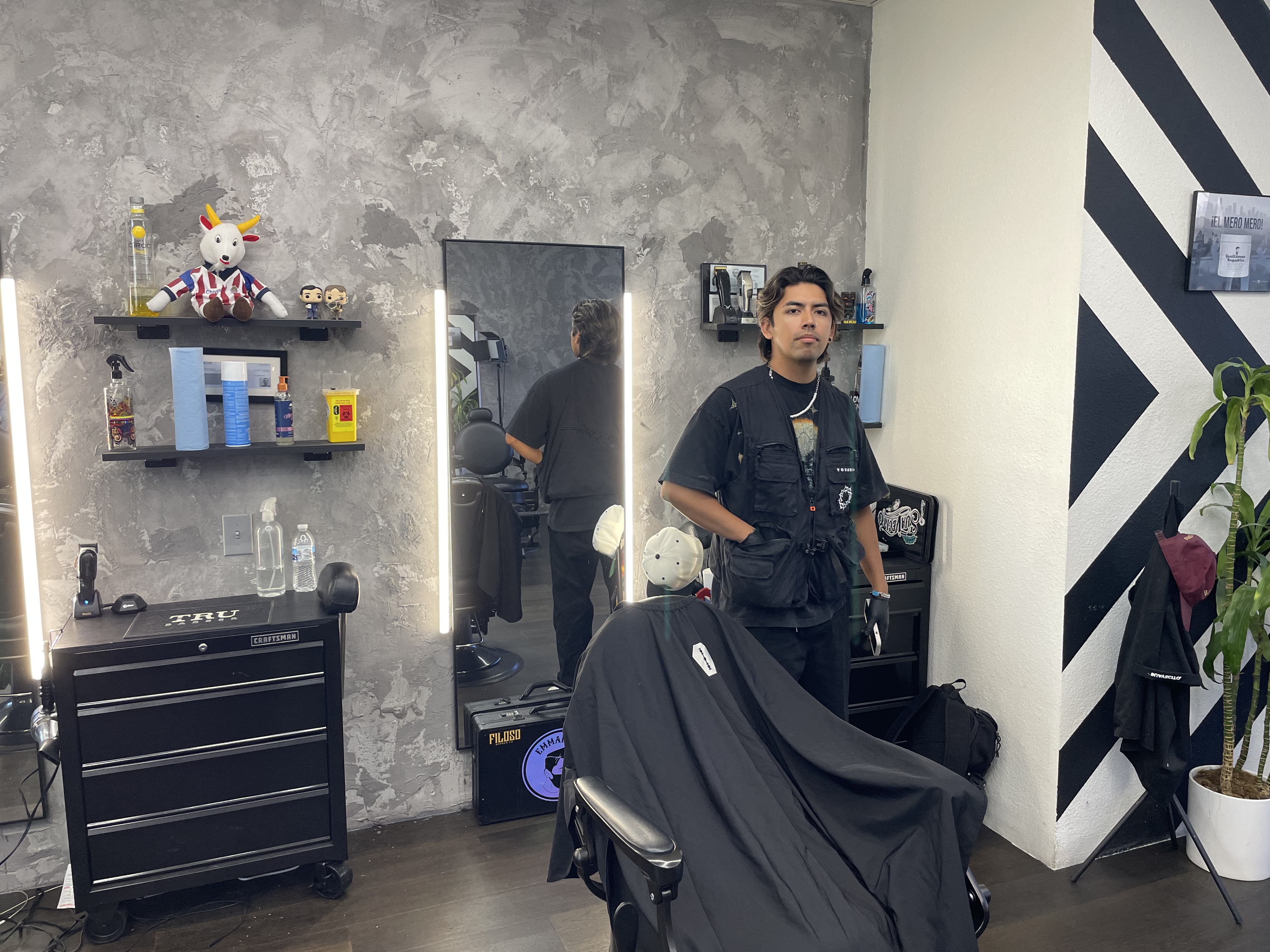
Emmanuel Garcia at his spot in the Filoso Barber Company in Vista, California
Emmanuel Garcia is a 24-year-old barber currently based in Northern San Diego County. For the past few years, he’s remained the number one barber in the area, specializing in medium to long-length hair. Now finally, the magician is ready to reveal his secrets.
On Tuesday, September 10th Garcia and fellow barber Alex Montes will teach a class divided into two sections. Montes’s section focuses on a more traditional cut, a slick back skin fade, while Garcia will branch out and demonstrate how to cut the infamous wolf cut, a new modern-day staple amongst men.
The barber community is a long-standing one that continues evolving with each passing season. Hairstylists are an inconspicuous piece of human infrastructure that we don’t often notice until the very last minute. That moment we know all too well when we look at ourselves in the mirror, furrow our brow, and say, “I think it’s time for a haircut.” We’re not even really aware of it even though your hair doesn’t ever stop growing. For some, it could be a nuisance, but for barbers like Garcia, it’s a beautiful fact of life and even an art form.
“My favorite thing about hair is that it just keeps growing. So you get to just recreate yourself or maintain yourself, and the longer you keep a haircut, the more ongoing the message is that ‘I want to be perceived this specific way,’ whereas the more often you change a haircut, you’re also showing, ‘I’m going through seasons.’” said Garcia.
A stroke of fate led Garcia down the path of haircutting. As a teenager, Garcia had to cut his hair to serve as a chambelán at a friend’s Quinceañera. However, after seeing the poor quality work from his local hairdressers, and not wanting to lose too much of his hair, he opted to cut it himself. Afterward, Garcia said his friends and family thought it looked pretty good, so he continued maintaining his own hair. Eventually, one thing led to another, and what then was an impulsive decision spiraled into a full-blown career path. Soon enough, he became his friend and family’s personal hairdresser, before renting a space at the Filoso Barber Company in Vista, California. Today, Garcia is the best barber money can buy for medium to long-length haircuts.
Gone are the days when the low-taper fade was the pinnacle of men’s style. Nowadays, men feel more encouraged to experiment and grow out their hair. This is especially true following the COVID-19 pandemic where many were forced to grow their manes due to major restrictions on person-to-person businesses.
In a way, men didn’t feel comfortable trying out different hairstyles until they were put in a position where they had no other choice. Garcia can relate to this himself, as he wasn’t encouraged to experiment with his hair until he was forced to by his friend’s birthday. In the end, his career followed like how it began, with him trying to learn ways to maintain a longer hairstyle. That being said, Garcia always felt comfortable with longer hair and quickly realized many men felt the same way.
A common salon experience for those with longer hair is when their hairstylist takes off too much length. So much to the point where they lose the effectiveness of their grown-out look. Miscommunications between clients and stylists often leave them with a haircut that’s impossible to put back together. Garcia, aware of this due to first-hand experience, knew he could be the solution. “I found myself getting more books by people with long hair because I had long hair and I was able to relate to what they did and didn’t want,” he said.
He finds cutting longer hair to be extremely rewarding and believes that longer hair will always be more customizable than shorter hair. “I’ll take this to the grave,” he remarked. It’s hard to disagree with him, as there are many ways someone can achieve a specific look with varying results. Often times it’s just a matter of getting there, subtracting hair until you’ve reached the apex.
This semi-recent trend in men’s style doesn’t come without its fair share of naysayers though. Purists exist in every artistic medium and hair is no different. There’s an unwritten rule in men’s fashion that’s made shorter cuts a permanent staple. Many barbers outright refuse to branch out and entertain longer hairstyles. Garcia recognizes this discrepancy and wants to close the gap.
On the topic, Garcia recalled multiple experiences he’s had with clients coming to him from other barbers, “A lot of my clients come from other barbers that shut down the client and so they ended up in my chair…And that gives me a lot of satisfaction, knowing that I was able to see their vision and bring it to life,” he said.
The differences between cutting long hair versus short hair may appear superficial to most, but Garcia maintains that the contrasting styles differ greatly in scale and scope. It requires different preparations, works different joints and needs different tools. To some, it’s probably intimidating as it’s a completely novel physical language but that’s also what makes it so exciting. The world isn’t always so kind to change, but longer hairstyles are reaching an unprecedented peak in popularity among men. Garcia says it’s here to stay.
“I really don’t believe long hair is gonna go away the way it did in like, early 2010 or 2018… I think people are just gonna start venturing out…,” he said.
In a way, that’s exactly what the class is about. Garcia is trying to widen the spectrum and lower the skill ceiling for barbers in North County. He wants people to move out of their comfort zones and try new things. The choice to split the class into traditional and non-traditional sections symbolically represents the fusion of both worlds into one cohesive mix.
In the past, Garcia’s released multiple tutorials on his social media about his iconic wolf cut but never before has he offered such an intimate look into his creative process. The class is a chance to see those procedures in a hands-on setting and really get to the bottom of what makes these cuts so intricate. That said, Garcia is also a fan of simplicity. He’s streamlined the hair-cutting process down to basic science and plans to teach the class in three parts. Starting with the prep work, then moving on to the length cutting, and finally ending with the styling process.
The class also acts as a farewell to his community as the following month, Garcia will be moving out of North County California. This will be his final chance to make an impact on his local community and spread his knowledge to the greater world around him.
“I have nothing to lose from everyone elevating themselves. I want them to see that it’s for their own good,” he said.
Emmanuel Garcia’s dual class with Alex Montes is on Tuesday, Sept. 10 at Filoso Barber Company in Vista, California.
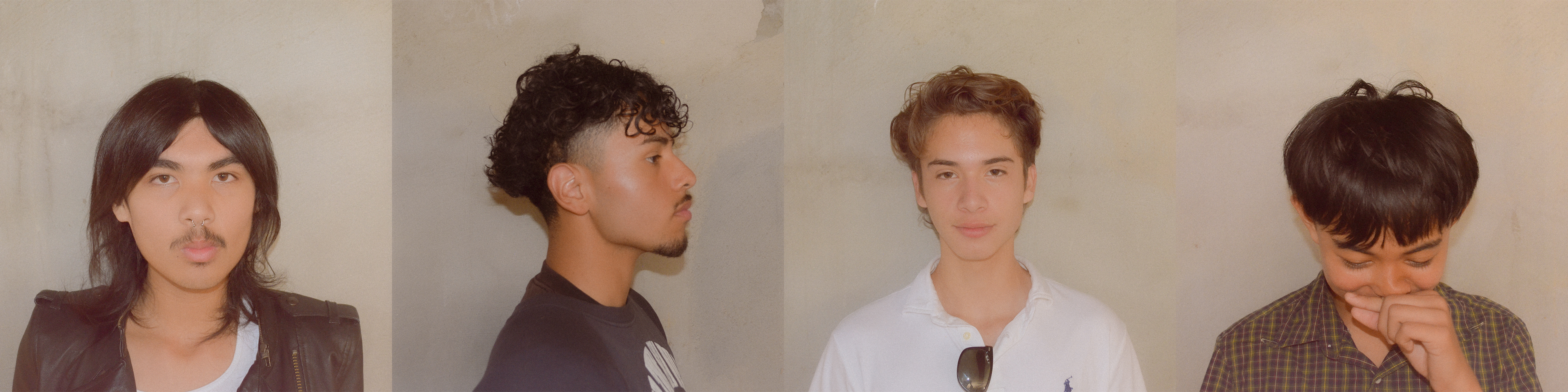
From left to right: Srisouraj, Rodriguez, Reyes and Felizardo. photography by fabian garcia
UnfilteredSD is the combined effort of four high school friends who share their love of vintage fashion by creating unique visual experiences associated with collections of clothing they curated themselves.
The group consists of 16-year-old Gabriel Reyes, Kanoa Srisouraj, Noah Felizardo and 18-year-old Nathan Rodriguez. They’re an eclectic bunch, each member of the team carries their own distinct sense of style and character. While it’s unfair to name a de facto leader, Reyes tends to speak for everyone in UnfilteredSD and spearheads many projects. That being said, the group values teamwork immensely and equally contributes something of value to every aspect of their artistic process.
As is the case with most resellers, the group began as average consumers, going to flea markets and various boutiques in the San Diego area. Reyes and Srisouraj were the first to come up with the idea of reselling clothing amongst their friends, Felizardo and Rodriguez came soon after and were the only two to “stick around,” according to Reyes. From that, a sort of brotherhood bloomed and they’ve worked together seriously for about a year now.
At first, they sold clothes from their personal closets alongside a few curated pieces. However, that was just a test run, and since then, the group has worked in many markets and made their way around the San Diego fashion scene. They’ve made good profits solely from their own sensibilities, but they obviously want more than money and local notoriety.
This month, the gang is dropping their most ambitious project yet, a collection of coordinated his and hers pieces all based around the concept of love, aptly titled “The Lovers.” Per their Instagram announcement, their aim is “through curation and promotion… showing raw, unfiltered, true love. Something that a lot of us lack these days.”
These are pretty big words from a group of kids, but strangely accurate given recent times. Indeed, it’s an uncommon angle to attack something as unnuanced as clothing curation, however, that is exactly what makes it so appealing. The group treats their business more like an independent brand than a typical vintage fashion curator would.
“So I like the business aspect, but I feel it’s more building a brand… That’s what I think sticks us out is that we try to build a brand as much as we can,” said Reyes. The rest of the group generally agreed with his sentiments but Rodriguez added, “We want to stand out and also because we want to make a story through curation, which like a lot of people, from what we know, haven’t done before.”
Outside of their aspirations, mindset is probably what sets UnfilteredSD apart from their contemporaries, that, and the fact the group is spread across 4 people with their own idiosyncrasies. They each fell into the so-called “fashion pipeline” of late 2010s streetwear at a young age, before eventually getting into vintage clothing and diversifying their tastes. However, how their individual palettes manifest in a teamwork setting is an interesting sight. The easiest way to demonstrate would be to describe the earliest step in their creative cycle, that being sourcing.
An average day of sourcing for UnfilteredSD is relatively simple and in preparation for their newest drop, they already had set ideas of what kind of garments they wanted to find, something that isn’t always a given. They arrive at the bins at around 6 in the morning, and as soon as the public is allowed inside, it essentially becomes a free-for-all. Each member spreads apart as far as they can, searching different bins and collecting hefty piles of potential pieces before regrouping at the end to vote out the ones they will and won’t get. A normal person may spend all day searching through each pile, but the group was finished in less than an hour. For the 15 garments they purchased, the total cost was $27 flat, a loss they could recuperate with the sale of only one or two items.
Everyone has a different approach to sourcing particular items, but the group is built on something of an honor system. They trust each other implicitly and communicate their exact plan of action before they make any major decisions. By extension, that also means they trust in each other’s tastes, something that isn’t always easy when you’re working with four different brains, but something they’ve managed to do with very little struggle.
“…for some of us, sourcing is like, where it starts. And then everything grows out of that,” said Reyes
After sourcing came the promotional end of their process, which included gathering product photos for their curated pieces and themed photography of models wearing their repurposed garments. This is where the gang can really flex their creative muscles. The product photos were shot on the floors of a private parking garage and managed to confuse only a few onlookers trying to use the structure for its intended purpose.
The modeling shoots were more of an involved process. Reyes, who came up with the idea for this particular set of shoots while listening to “I Wanna Be Down” by Brandy in the shower, wanted their promotional photos to portray people on innocent dates, wearing cool outfits. Everything was to be styled by them, of course.
On the day of the shoot, Reyes purchased ice cream cones for the models to use as props. “An ice cream date,” he said with a smirk. However, it was an outdoor shoot and the conditions were not very favorable to the vanilla cone he had just scooped. Liquid Ice cream dripped onto the model’s hands and left a small trail as the couple walked around the park they were shooting in.
Srisouraj was in charge of photography that day while Reyes shot the video for a promotional film that’s set to release alongside “The Lovers” official drop. Despite the production issues the two were committed to their vision and managed to get through the shoot better than the ice cream did. The photos came out great and articulated the unfiltered and nostalgic vibe Reyes was going for.
“I think that’s also what makes us like, kind of unique is how we incorporate our film and our pictures,” said Felizardo.
“Our storytelling,” Reyes added, echoing Rodriguez’s statement from earlier.
Another brash claim from the young entrepreneurs, but one they seem prepared to defend. Not just through their words but from pure ingenuity and perseverance. As far as the future goes, the gang is looking to expand across California and eventually drop the SD from their name, meaning they won’t retire anytime soon.
On the topic, Srisouraj said, “I think this can be a long-term thing and I do see it as that. I also like the fact that it’s also an outlet, where we can all like contribute something.” Whether that means owning a boutique or starting their own market, we will just have to wait and see.
If one thing is clear, it’s that there is no shortage of creativity coming from the youth of San Diego.
UnfilteredSD’s “The Lovers” Drop will be released on July 26th and premiere at Hot Spot Flea Market in San Diego on July 27th.
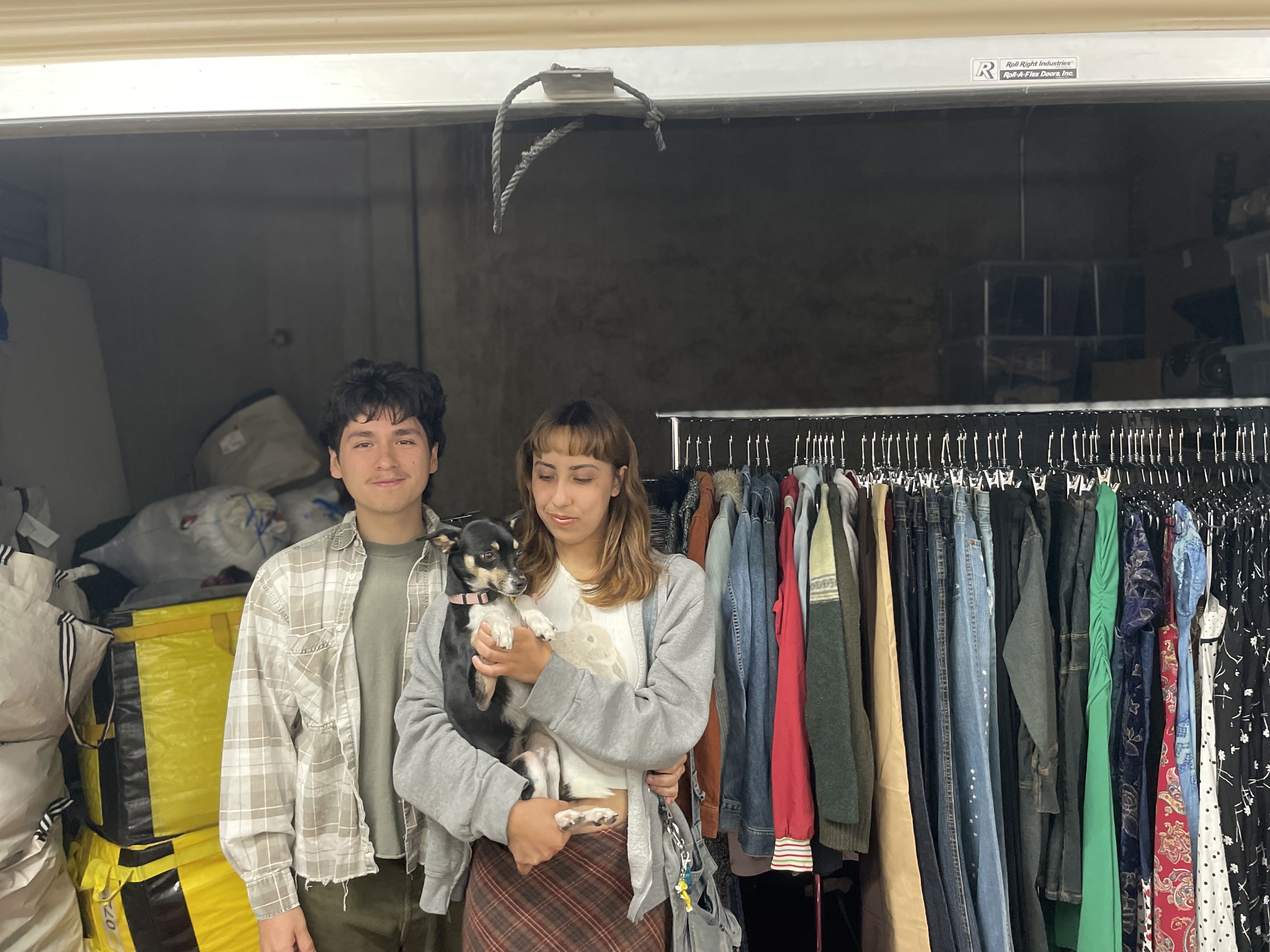
Reyes (left) and Kircher (right) in their storage unit
Deep within a random storage unit in San Diego County, a treasure trove of clothes sits on stacks atop a red rug. The inside is like a thrifter’s dream, with vintage clothes and old antique goods covering the exposed cement walls. This is the unofficial HQ for 21-year-old Adrian Reyes and 20-year-old Alia Kircher. The couple runs two separate businesses Chop Shop and I Luv Figs alongside a joint store called doesyourbellyache? As if that wasn’t enough, they also manage one of the most popular flea markets in San Diego County known simply as Hotspot.
Despite how it may look, the storage room is an organized chaos for Reyes, who easily described the rough layout of everything in the dense locker. For Kircher, it’s a different story, “There’s been times where I just let Adrian come here. And I’m like, ‘can you just get this, this and that?'” she said while laughing. It’s an obscure dilemma for most, but it’s just another weekday for resellers like Reyes and Kircher. Before owning a storage unit Kircher stored their stock in her garage, but as fast their business ventures expanded their space decreased.
Since childhood, Reyes and Kircher have been surrounded by not just fashion culture but also picking culture, both shared numerous childhood stories of going to thrift stores with their parents and filling their carts full of clothing. They laughed while describing the mutual disillusionment felt from seeing thrift culture becoming acceptable in modern society. Kircher began selling when she was 16, first on Depop before doing markets at 18, but Reyes said he’d been vending at flea market events since he was 13.
It’s been a long time coming for the business partners, they’ve explored the flea market scene in San Diego in its entirety and for nearly two years they’ve carved a little piece of it out for themselves.
The Hotspot Flea Market began on August 20th, 2022 with Kircher as the sole coordinator. At the start, Kircher’s only desire was to have a space for herself and her friends to get together and have fun in one place. Since then, it’s completely spiraled into a small cultural hub where people join together and share their love of art and vintage goods. A place where old vendors and new vendors alike can engage with their customers on a personal level.
That being said, a pleasant experience is always on Kircher’s mind each time she and Reyes set a new date for Hotspot. “…I think now I see more of like, an opportunity to help like a lot of sellers in San Diego or SoCal. Like, just to have a place to vend you know, and, like a fun place to vend. It’s still about having fun and I think that’s our main thing we try to have everybody’s experience like a good experience,” said Kircher.
Reyes joined as co-owner after the first Hotspot event and since then it’s been a joint effort to continue to make the market a safe and inviting environment. There are a lot of flea markets native to San Diego that accomplish similar results, but very few have tried to expand as widely as the couple has.
Ultimately, Kircher and Reyes are trying to regulate a market that is completely unregulated by design. Reselling is like the Wild West of commerce. Instead of going through traditional brick-and-mortar, you’re interacting with sellers individually. Each time you buy from one you don’t necessarily know the personalities and mindset they have going into it. The couple intends to alleviate that experience and guarantee customers won’t have to worry about the kind of people they’re purchasing from.
“I think we really try to pick vendors that have great customer service because I think with reselling… you don’t have a boss… you don’t have like a boss telling you like, you have to be nice… I think everybody that sells at hotspot is a representation of us,” said Kircher
Reyes was quick to also put the responsibility on market owners as well, “if you’re not putting out good energy and setting up all of your vendors and stuff to like, have a good day. It’s not gonna be like a good market,” he said.
Despite their good intentions, the couple expressed personal hardship in maintaining this level of decorum. Not everyone holds themselves to the same standards they do and because of the nature of reselling, it’s very easy for things to get personal. On this topic, Reyes said, “The fact that this business is so unregulated. I feel like there’s really the opportunity there for your business to really mesh with your real life, like your actual life… It’s difficult to navigate for sure.”
Both expressed how much of a blessing it’s been for reselling to be their full-time job, but they ultimately distanced themselves from others who place themselves on an unrealistic pedestal. Personal profit from their market is not their priority, instead, the overall experience of Hotspot is their main concern.
“Even if people don’t spend anything, like even if they come with $0 I’d want them to have fun… sometimes I don’t really care about more about the money that’s like coming in, I care more about the energy and the experience that people have so that they want to come and that they don’t feel left out…,” said Kircher.
In the future, Reyes and Kircher are planning to expand Hotspot further and make the event more event-based than purely commercial. In the past, they’ve experimented with night markets, live DJ sets and food vendors. They’ve even hired artists to do cosmetic jewelry on-site. The couple wants to continue in this direction, essentially turning Hotspot into a community space that just so happens to have vendors.
Their forthcoming Hotspot event on the 22nd of June represents the fruits of their labor. It will be hosted at a new location featuring live bands and a 1 dollar clothing pile. In addition, 50 percent of the admission sales and 100 percent of the profits from the pile will be donated to the Rape, Abuse & Incest National Network (RAINN) the nation’s largest anti-sexual violence organization.
On top of being partners, resellers and event coordinators, it seems the couple wants to add philanthropists to their growing list of titles.
Of all the emerging trends of recent cinematic history, one of the least promising has to be the decline of media interpretabiliy.
While directors have always been open about sharing their work, never before has the “meaning” or “purpose” of something become such a heavily scrutinized point. Whereas some experimental auteurs of the past like David Lynch remove themselves from their personal interpretations, modern directors seem much more interested in sharing what they believe their stories are about, rather than allowing the audience to live inside of the world and come to their own conclusions.
This could be a side effect of multiple changes to the film industry. Press runs are much more prevalent to the average consumer and there are far more avenues to engage with a given piece of media. Creators also have a direct line of communication between themselves and their viewers through social media, subsequently disadvantaging artists who wish to remain more private. Given that this level of openness is relatively novel, it paints a gloomy picture of the future of what could be considered the new echelon of “experimental cinema.”
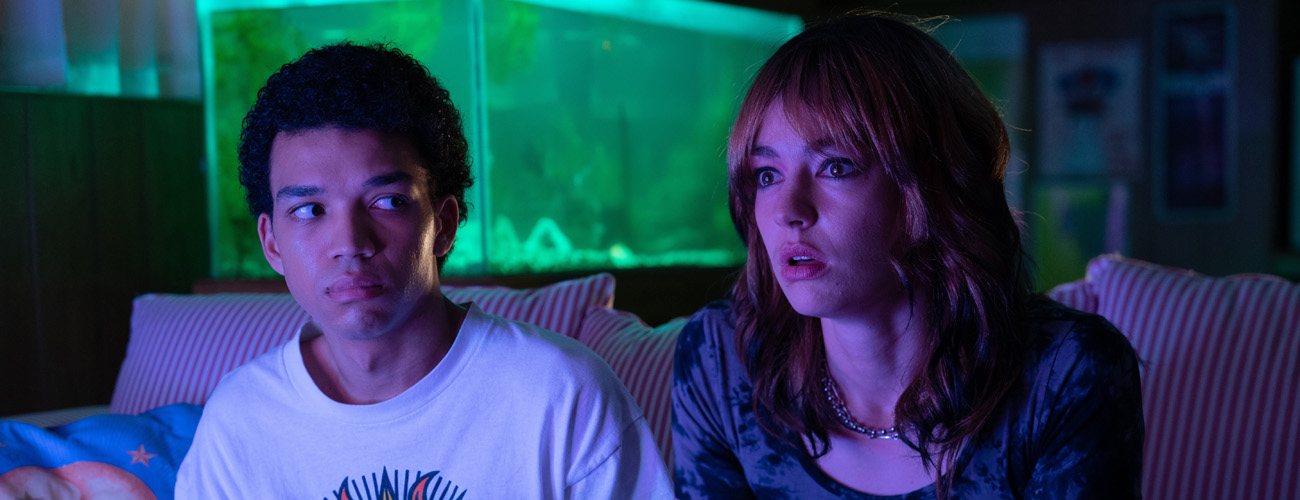
“I Saw The TV Glow” is the newest film from A24, an indie film company turned movie titan. Since its release, director Jane Schoenbrun, who identifies as nonbinary and trans, has been very open about what they believe the film is saying and what they hoped audiences would get out of it. While that doesn’t necessarily mean there is zero room for new analysis, when an unconventional and visually robust film such as “I Saw The TV Glow” releases with an already set-in-stone definition, one cannot help but feel a tinge of disappointment. It’s almost as if any other interpretation is invalid as a result of Shoenbrun’s candidness.
We’ve seen this scenario repeat itself almost beat for beat with the Matrix series of films. Co-director Lilly Wachowski revealed in a Netflix interview that the Matrix was meant to be a “trans allegory” but claimed the world wasn’t “ready for it.” She would later backtrack on these claims in a separate interview, saying that her response was misrepresented by Netflix, but by that point, her previous statements had already been broadcast by most popular media outlets. In contrast, Schoenbrun has been very clear on “I Saw The TV Glow” being a trans-coming-out story, and as of writing this, they haven’t stepped away from that interpretation whatsoever.
Ultimately, what we gain from both instances of directors sharing their opinions on their own movies is a lesson in perspective, more specifically, the effects that come from a single-point perspective. In the case of “I Saw The TV Glow,” it’s also the perfect case study on how an artist can be so incredibly wrong about their own work.
It’s only natural for a director like Schoenbrun to jump the shark as soon as they begin. It’s not a benign condition, it’s common for many auteurs who are entering the film sphere. “I Saw The TV Glow” just so happens to be a unique case due to its subject matter and immediacy.
For all intents and purposes, “I Saw The TV Glow” seems like a continuation of the same themes Schoenbrun developed in their second film “We’re All Going to The Worlds Fair.” They’re both tales of obsession, childhood nostalgia, and the darkness of growing up. Both films also intend to recontextualize teenage socialization, with each interaction between the main characters feeling uncomfortable and borderline cringe-worthy. This is all just to say, that the connective tissue between both films is very explicit.
That being said, “I Saw The TV Glow” takes things a step further. It very plainly lays itself out for the audience and follows a much more streamlined narrative. There are no playful intermissions or experimentation with media forms. Instead of the socially conscious internet-driven presentation, left in its place is an unmistakably modern take on a retro aesthetic that only exists in what we remember. One could call this intentional, as “I Saw The TV Glow” seeks to rewrite an already reminisced history, but in the same vein, there is a lot of deliberate effort put into the production design that says otherwise.
This is hardly a negative, and something that most nostalgia-latent films do partake in as well, but regardless it’s an important distinction to make clear before anything can be said about the not-so-hidden subtext of the film. The visuals are meant to say a lot about what our main character experiences and more or less determine the trajectory of the story. Time periods and the overall process of time itself play a very important role in developing our tragic protagonist, Owen (portrayed by Ian Foreman initially, then by Justice Smith), and seek to suspend our disbelief further.
For instance, parallels between Owens’s seventh-grade self and Owens’s ninth-grade self seem to reflect his lack of maturity. In a long tracking shot, both versions of Owen walk to his friend Maddy’s (Brigette Lundy-Paine) house with the same level of awkwardness and hesitation despite the two-year gap between both instances. In another scene, a seventh-grade Owen is shown lying in the back of his parent’s car, asking his mother’s permission to hang out with a friend. A scene later in the film, frames ninth-grade Owen in the same position, once again asking his parents permission, this time to stay up late.
This is a recurring theme throughout the film and haunts Owen even into adulthood. It’s implied this is due to an inherent fear Owen has of his own father, but it’s also worth pointing out that Owen responds to all forms of command and control, even from Maddy. Only twice does he make a decision for himself and both times it’s for fear of disappointing another commanding figure.
It seems more apparent that Owen simply respects the rules of seniority. Throughout the film, Owen is never really seen interacting with people his age, instead, he becomes a vessel for others to take advantage of. From this, it would appear his history of inaction seems to be more a side effect of his permissiveness rather than an intrinsic lack of autonomy. The fictional in-universe TV show Owen and Maddy obsess over “The Pink Opaque” highlights this character trait further.
“The Pink Opaque” is marketed as a TV show for young adults, immediately enticing Owen with the prospect of appearing older and therefore more mature, a very common desire for younger teens. Maddy’s status as a “young adult” adds to his disillusionment with his own age group and sense of self. Owen idolizes not only those seemingly superior to him but identifies himself with parts of them. This is precisely how he becomes engrossed and captured by the hands of the media.
Both Owen and Maddy seek solitude and escape in the fictional media they consume, allowing it to take hold of their lives and perceptions. Maddy, who is also a victim of media manipulation infects Owen with her own visions and preoccupations. It manages to reach a point where she becomes convinced they’re living the alternate lives of the main characters from the show, all set in place as an elaborate rouse by the fictional in-universe villain Mr. Melancholy. While Owen rebukes these claims telling Maddy, “It’s just the suburbs,” the damage done to his impressionable mind has already made its irreparable mark.
It should be stated that both characters appear to come from difficult home lives. Owen outside of his fear of his father also silently grieves the declining health of his mother and Maddy lives with an abusive stepfather. This essentially makes both characters the prime targets for media escapism, but what’s more harmful is the irreversible psychological damage that seems to come from both sides of abuse. They seek to insert themselves into the main characters because they possess traits and opportunities simply not present within their existence. However, this incidentally propels them further into a cyclical state of disillusionment with reality. Their method of coping is self-destructive and further estranges them from society and reaching their potential.
By the end, Owen is caught in an unfilling cycle of existence, surrounded by the childhood that eludes him. Memories of birthday parties and the old TV shows he used to enjoy fade into obscurity as he’s surrounded by an indifferent world. It’s not so much that the world he’s living in is miserable, it’s that he’s miserable living in it. It’s not like the mystical world shown in “The Pink Opaque.”
Shoenbrun interprets the ending as equally tragic but for a different reason. They see it as Owen refusing to accept his true self, the fact his real body is in “The Pink Opaque.” Even as Owen quite literally opens himself up, he rejoins the world apathetic to his plight. Owen is lying to himself and the audience. In the end, he is forced to live a passive life, conforming himself to the constraints world around him. It’s a rather literal interpretation, and for a film with such a unique style, it doesn’t present something very interesting nor does it extend past the walls of the story at hand.
What seems more likely is that the poignant ending acts as a cautionary warning. It’s a pointed reflection of the audience, a look into the lives of those who allow the media they consume to control their hollow existence. It’s what happens when we let the media we consume define us and cultivate our understanding of ourselves. It’s what happens when we refuse to open ourselves up, and accept reality as reality. We carry on living the delusions we keep inside our heads and expect the world to validate them simply because it’s how we feel.
Don’t watch the artificial TV glow, instead, let the sunshine in.
One of the most common motherly hyperbolies we hear in early childhood is about how far they would go to protect us. Usually something along the lines of, “I would hurt anyone who tries to lay a finger on my baby.” While this statement is obviously not meant to be taken literally, it nonetheless instills a level of morbid security in our sacred youth. It makes you wonder the extent a parent would actually go to safeguard their child against the harms of the world.
Hur Jin-ho’s 2023 film, “A Normal Family” demonstrates what these lengths could theoretically look like and then some. It’s a Korean adaptation of a Dutch novel called “The Dinner,” which has already seen several adaptions beforehand from multiple countries. This one, out of all of them, seems to be the most positively received by audiences, a rather small feat considering its dull peers.
The film begins with a scene of road rage between two belligerent strangers: a father driving his daughter and a teen recklessly driving his Maserati around. The interaction results in the teen driving his car into the father, killing him, and also critically injuring the daughter. This event sets the film in motion as our main characters are loosely connected to this moment but it also demonstrates the most common motif seen in the film. The interconnectedness of family and how our actions and consequences often cause a ripple effect, condemning more than just ourselves.
Representing the driver in court is Jae-wan (Sol Kyung-gu), a shady defense attorney who uses the law as a cloak to disguise and manipulate reality to his liking. Brother to Jae-wan is Jae-gyu (Jang Dong-gun), a doctor working at the same hospital where the daughter from the start is receiving treatment after being crashed into.
Early on, Jae-gyu is posed as the de facto protagonist: he’s appalled by his brother’s complete apathy when Jae-wan asks him to ask the daughter’s mother to take a settlement deal, he works in a more respected profession, and, most importantly, he prides himself on his strong moral compass. Their main unifying factor stems from their shared experience of fatherhood, although they have very contrasting parenting styles that end up leading to the same place as the film goes on.
Jae-wan, father to Hye-yoon (Hong Ye-ji), becomes more distant from his eldest daughter as he rears a new child from a new wife, hoping that the lavish lifestyle that he provides will suffice his absence. On the other hand, Jae-gyu is a father to a son, whom he’s extremely firm with. Jae-gyu wants his son to build his own path, rather than taking any handouts from him. The only real similarity between both of them is their high regard for education. An unremarkable footnote, given the near-universal importance of education in Korean culture.
By and large, a child is the reflection of the parent’s values and teachings. They’re placed in particular environments that present decisions to that child, the consequences of those decisions then shaping the child into an adult. It’s an endless cycle of regression and progression, and a parent can only hope that their child will do the right thing. “A Normal Family” highlights this fact of life constantly, especially after the main conflict of the film reveals itself.
The parents’ respective children end up putting a homeless man in critical condition while they are away at dinner, thus, presenting a caution – despite a parent’s best efforts, their children still select their own path. It can be argued this moment in the film is identical to the first conflict shown at the beginning. An act of violence causes a ripple effect that reflects not only on themselves but on the rest of their family. An all too obvious parallelism that ultimately doesn’t reveal much more than it did initially.
As expected, Jae-wan attempts to slide things under the rug, while Jae-gyu at one point attempts to turn in his own son to the police. However, as more information is revealed about the circumstances of that night, and the death of the homeless man comes to pass, the roles between the fathers begin to shift.
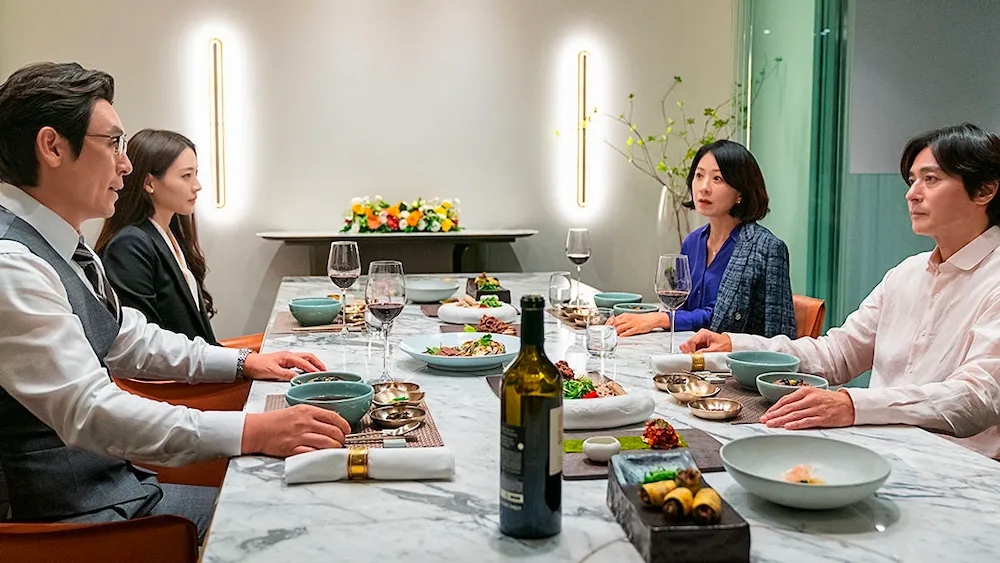
However, this shift is where the film begins to falter. Although the movie highlights this internal conflict of moral compasses and the cognitive dissonances that tend to take over once one’s children are involved, the reasonings behind the shifts in opinion are contrived. Furthermore, the poor execution is highlighted by an underwhelming climax in which the families argue in a poorly directed dinner sequence.
On one hand, it can be said that Jae-gyu switches not only because his moral compass falters because of his love for his son, but because he simply wants to surpass his brother, wanting to be contrary to him. This stands perpendicular to the film’s theme Jae-wan says at the beginning, “Everybody gets weak before their children.” Rather, Jae-gyu becomes weak before his brother.
On the other hand, Jae-wan, originally set on allowing his daughter to get away with murder, suddenly has a change of heart when he discovers that the children actually don’t feel any remorse for their actions. This scene has no emotional weight to it as it is plainly obvious that Jae-wan’s daughter does not care. Multiple times throughout the film she expresses clear apathy towards being an accomplice to the murder.
As a brief aside, I am currently attending law school and thought it’s interesting that it never once crossed Jae-wan’s mind that he is now an accessory after the fact as he intentionally helped her evade arrest, knowing that she committed a felony.
I digress. While Jae-gyu’s switch is offensive on a thematic level, this switch is offensive on a storytelling level as it completely telegraphed what is going to happen in the penultimate dinner scene where Jae-wan expresses that he must uphold the law, while Jae-gyu sees it as his duty to protect the integrity of his son. Effectively, the dinner scene renders the surprise ending scene, as lackluster shock at best.
Although the film possesses an interesting premise, it sputters in the finer details about presenting the central conflict, resorting to an obvious shock ending that unfortunately is not enough to leave a lasting impression about parenting or family life.
The San Diego Asian Film Festival returned for its 13th spring showcase with one of its most interesting exhibitions—an entire Sunday dedicated to films directed by the late Tibetan filmmaker Pema Tseden. Four films, from his second feature to his most recent film, were on display at Ultrastar Cinemas in Mission Valley. We caught the second film out of the quadruple feature, his 2015 film “Tharlo.”
“Tharlo” follows the same narrative beats as a Greek tragedy or a modern folktale. An orphaned man with no real name must find his bearings in a society that has largely ostracized and sequestered his kind. Despite appearing a mostly well-spirited individual, he finds himself at the short end of every stick, unable to adapt to his metropolitan surroundings, representing the ideological impasse between rural and urban Tibetan life. Tharlo, the titular main character portrayed by Shide Nyima, acts as a medium, a theoretical bridge between the two worlds. A fact made even more apparent through the various characters he meets throughout the story.
At its core, “Tharlo” is about how far someone is willing to go to escape loneliness, that irreconcilable feeling something is missing from your life. Almost as if, you haven’t lived enough to be considered a full human being.
Tharlo doesn’t speak very much throughout the film, despite it being named after him. His permissive tendencies eventually lead him down a path of despair and uncertainty. It displays not only an ideological difference between the various lifestyles of the Tibetan people shown in the film but also a sociological one. It’s not so much that Tharlo is a victim of naivete, more so a victim of unfair ignorance. He is inherently trustworthy of people due to his lack of exposure to people as a whole. He blindly reciprocates and follows the words of others due to a perceived sense of inequality or authority from most people around him. His strange quirks and idiosyncracies are exploited constantly for personal gain or just plain amusement.
The only time where Tharlo is in any kind of peace is when he is alone on his goat farm, an environment that quickly eludes him after his exposure to alternative lifestyles, almost as if he has been corrupted by it. A powerful scene displays this point very clearly, Tharlo sits upon a rock watching his goats herd themselves into a small clearing. They move farther and farther away from him, whilst the frame slowly converges on his isolated figure.
Most of the deeper themes in “Tharlo” are expressed like this. They’re typically visual and almost purely subtextual. It toes the line of slice-of-life more than melodrama. This is likely because the film doesn’t follow the same constrictions of a traditional narrative film. Its neo-realist style is more akin to a well-staged documentary or even cinéma vérité. The camera often sits in a single spot for a long time, portraying Tharlo’s existence rather indifferently.
However, it would be unfair to say that the film isn’t without a sort of bias built into its skeleton. The film is a tragedy after all, and Tharlo plays the fool throughout most of it. Whether Tseden is alluding to a preference toward one viewpoint over another is probably unimportant either way. We are meant to identify with Tharlo because the film is ultimately about his experience. In a way, he represents tradition as a whole. How most will largely leave it behind to advance as quickly as possible, a sort of forced adaptation to which Tharlo willingly complies.
In a Sampson-esque turn of events, his hair is shaved off, stripping him of his strength and overall sense of self. He’s completely transformed, his previous life, is just a memory. What is left is all he can see through old Tibetan eyes.
I remember the pitter-patter of the rain falling on the leaves above me, the noise almost indistinguishable from the raindrops falling on my jacket. The rushing water about five steps to my right attempted to drown out these sounds but the unique tone simply couldn’t be washed away. The flowing force of the once small creek was impressive, vast waves of flowing water passed by me in an instant. Although beneath the flow of water now, it was clear the land underneath would forever be altered. The scent of a damp landscape was still effervescent as if the leaves had been steeped like tea. Small saplings look as if they were trampled by a tractor, while sediment and silt replace land once littered with leaves. The receding water revealed an assortment of odd trinkets that flowed down from the power of the most recent storm. In a previous downpour, I had found a buried camera, caught by the flowing water. Wondering if anything could be salvaged, I realized that the SD card could still be read. Inside the SD card were photos of a raccoon modeling for the photographer. The camera was a trail camera, and there I was, peering into the life of an unknown mammal. Magic doesn’t need to exist when we have places like this to experience the miracle of a message in a bottle. The raccoon looked beautiful in their photoshoot by the way.
Everything here seems special, as if it was made specifically for us to experience.
The only permanent thing in our lives is the forever-changing nature of it.
If I don’t hear the splat of a raindrop on my roof at night I get concerned now, it’s no longer special. There’s a mangrove in my backyard where the mosquitos like to bite my ankles. I’ve only been there once, as a once elusive ecosystem becomes commonplace. I adore the outdoors and all those species of plants and animals we share this planet with. The air and ocean are soothing here in the Philippines, and the land is beautiful. Born and raised in San Diego, I had unknowingly developed a deep connection with the land and nature that constitutes San Diego. I am a foreigner here in the Philippines, as I’ve expressed in my previous writings, but this is pronounced in my lack of a connection to the land, how I look out at the land and I can’t understand what they’re trying to say. I used to sit down on a bed of leaves without a care in the world. The ants biting my ass, the leaves falling on my head, and the sound of footsteps from the locals in a nearby bush. I took in deep breaths to feel alive, to feel a connection. Now I don’t have a bed of leaves to sit on here, the ants bite harder, and the footsteps are unfamiliar.
But everything is always changing, including myself and those living around me.
Back in San Diego, spending enough time outdoors felt like a conversation. I would listen, then listen some more, never needing to speak. With that, I could make an educated guess as to the previous lives of the land. The grasslands that pop up after a fierce fire look different than the grasslands that pop up after intensive farming. A forest removed from the fire has a distinct character from one thriving despite its combustibility. The land holds the memory of what came before, this is most evident from fires as land always has something to say about the flames that were once there. I’m still learning to speak the local language here, step-by-step, or “amat-amat” in Hiligaynon. I still don’t have the skills to listen and read the land here but I will get there, amat-amat. For now, though, I can revel in yet another opportunity to learn from the land surrounding me. It’s as if I am a kid again realizing what it means to live in this world. For all the shortcomings I am aware of today, I remember where I came from, and feel humble knowing I have my entire life ahead of me to learn.
The past is only experienced today as is tomorrow.
Living on a relatively small island, I could travel from the eastern edge to the western in one day. I watched the sunset with friends I’ve made in the past six months. Thinking back on all my experiences, nothing compared to what I was doing as I watched the sun setting. I returned from that trip to a broken internet cable that completely disabled my ability to check the internet. I couldn’t call my friends, and family, or even make future plans. I was stuck in the moment and truly nothing compared to what I was doing as I stayed bored in my apartment. I’m just happy for all that I’ve been fortunate enough to experience, even if the present ain’t anything special. My life has been anything but stagnant, so what’s next?
The present, the very thing we are experiencing right now is all that’s guaranteed.
Who knows what the future holds for the places I call home now? All I know is that I blame so much of the wrongs in the world on those who came before. Why, just why, did I inherit a planet steeped in a climate disaster? Steeped in inherent racism and xenophobia. Steeped in inequality of resources. It’s heavy experiencing these atrocities without having an idea of what could be, a future worth fighting for.
The river yearns for the water to fill up their streams until they’re unrecognizable, and the forest thirsts for flames, what do we need to quench whatever it is we lack? We find comfort in what we find familiar, but rarely do we regret the change. When there is a lack of change, a lack of novelty, suddenly we feel as if we are at a loss, as if we can’t do anything for the betterment of ourselves.
About 4 billion people live in urban areas, half of the world’s population, and many have lost this intrinsic connection to nature. I set out today just to write about the inability for many to experience, to breathe in all that nature offers, but this inability cannot be spoken about in isolation. Addressing just this one atrocity is like bandaging a massive wound. I must believe in a world worth fighting for, but what does that look like, how can we collectively act for the betterment of humanity?
The world is always changing, so let’s change it to something we want our grandkids to inherit.
DISCLAIMER: The views expressed are my own and not necessarily those of the Peace Corps or the U.S. Government.
Hello, this is a redirect to an article I wrote for Stranger’s Muse about Water From Your Eyes’ opening set they played at the Observatory in Santa Ana.
Photography was also done by our resident photographer Raymond Skinner.