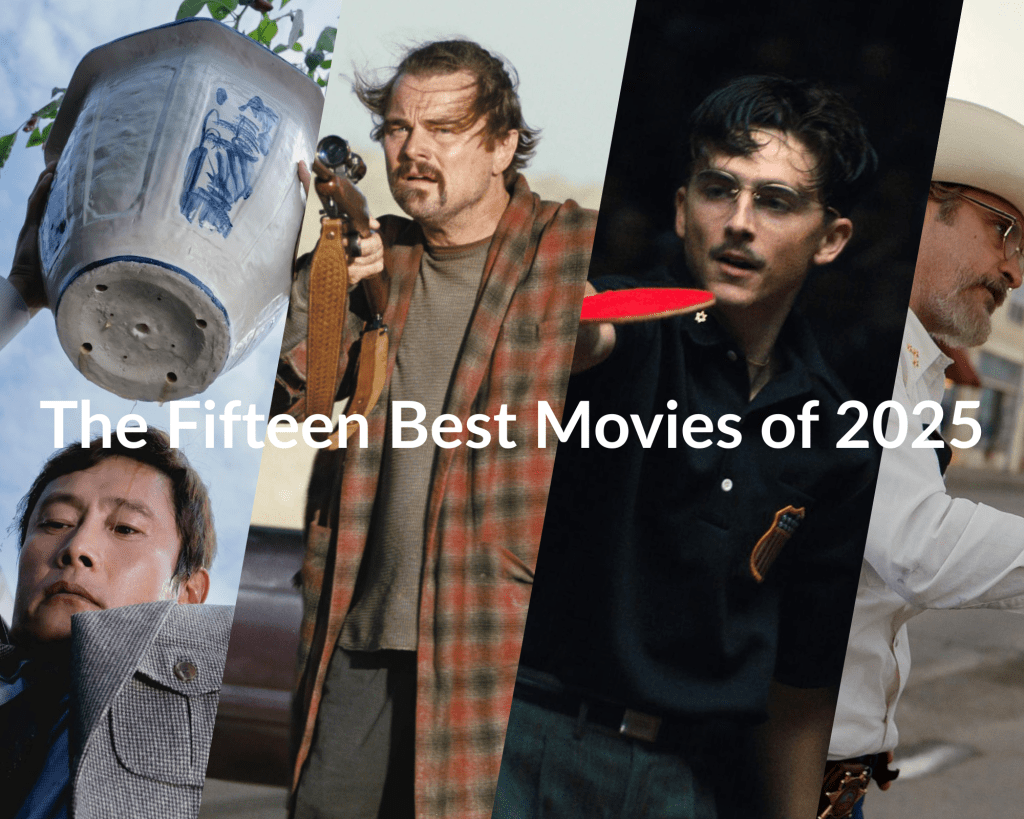
2025 was a significant improvement for cinema compared to 2024. Not only did we see a skyrocket of beloved original movies financially succeeding at the box-office such as “Sinners” or “Weapons,” creating memorable cultural phenomena, but in general, original movies seemed to have exclusively made up the best of the year. This list will highlight fifteen of them, in order of their U.S. (theatrical or limited) release dates.
“Hard Truths” (Mike Leigh)
January 10, 2025
The newest feature-length from one of England’s most beloved directors, Mike Leigh, “Hard Truths” showcases perhaps this year’s greatest performance by a leading actress from Marianne Jean-Baptiste. This is a strict character study on one of the most insufferably miserable characters you’ll meet all year, who’ll offer up some laughs here and there, but moreover, a deeply recognizable feeling of despondence that you can only get when it’s directed at a loved one. Why she wasn’t nominated for an Academy Award last year is honestly beyond anyone.
“No Other Land” (Yuval Abraham, Basel Adra, Hamdan Ballal, Rachel Szor)
January 31, 2025
There’s so much to unpack with “No Other Land” and how its existence to begin with is an unlikely blessing in and of itself (the collaboration between a Palestinian activist and an Israeli journalist), but what struck me the most about this documentary is how it intimately depicts protesting. This movie can be so personal that it feels like you’re reading someone else’s diary, immersed in their struggle and strategic journey towards preventing as much destruction as possible of innocent people’s livelihoods. There’s really no disadvantage to watching this just to learn about even a small piece of what’s happening in Palestine, because it’s applicable knowledge to gain towards understanding this kind of corruption and retaliation that finds its way in all types of land across the globe.
Misericordia (Alain Guiraudie)
March 21, 2025
While potentially inspired by the works of Mr. Ripley adaptations and even this decade’s “Saltburn,” “Misericordia,” despite its obvious parallels, still manages to feel wholly original. Not only does this succeed as your typical fugitive thriller, but it’s also a profoundly interesting movie about esoteric allegiances and collective consciousness, all accentuated by its rural small-town location. Impressively, it’s a very sexual movie as well, despite having no sex scenes, which contributes towards its thesis on how powerful the idea of sex alone is to people, even when detached from it actually happening to someone. If you’re a fan of directors such as Michael Haneke or, dare I say, Alfred Hitchcock, then I highly recommend this slightly more jocular exercise of their filmmaking.
“Baby Invasion” (Harmony Korine)
March 21, 2025
Forget movies that are hyperfixated on nerdy, retro aesthetics to enable our comforting nostalgia. Here’s a movie for people who are actually capable of getting over the past and moving on, a movie willing to indulge in our bleak present of dehumanizing entertainment so that its audience can be earnestly transported. It’s perhaps this year’s boldest cinematic experiment, which is worth a watch alone, whether you end up liking it or not.
The Phoenician Scheme (Wes Anderson)
June 6, 2025
“The Phoenician Scheme” is like if the story of “The Royal Tenenbaums” got “The Grand Budapest Hotel” treatment in execution. Say what you want about Wes Anderson, continuing to pump out work that perhaps alludes to the fact he already peaked, but he still has yet to make a bad feature-length in my eyes. Even though he’s clearly just throwing everything at the wall and seeing what sticks at this point, remixing his past work in a perhaps not as commercially appealing manner, as long as it continues to be perpetually funny and cinematically inspired throughout, then I really don’t see a reason why I should solely be hating.
“Eddington” (Ari Aster)
July 18, 2025
First and foremost, I appreciate director Ari Aster for making a cinematic time-capsule of COVID-19 and working it into his other grievances towards the modern world, such as with the affirmative internet and our militarized smartphone cameras. Whether you think this movie has enough to say or not, it’s nice that it at least exists as a relatively honest and scrutinized depiction of a historical moment that’ll likely become irrelevant to future generations. “Eddington” is about how people stand by their said beliefs secondly, and stand by their true desires firstly, which is a tale as old as time; there’s just BLM and #MeToo on this episode of it.
Through many characters, Aster attempts to explain how people’s qualms and problems with the world are oftentimes, if not always, the byproduct of personal vendettas, which is the key as to why nobody can totally grasp another’s point of view unless perhaps they went through something homogenous. It’s funny to read any sort of controversy about this movie regarding its refusal to bring up certain movements, organizations or events that were also prominent during COVID-19. There’s an irony to viewers caring more about the topics they personally value being represented in this movie than self-reflecting with what it’s trying to say about how these politics divide us and cultivate hatred when their attention is not met with unreasonable agreeableness, given we all come from different experiences, so understanding each other’s developed beliefs is simply not that easy.
Despite Ari Aster’s trademark cynicism, however, I think the more obvious real-life parallel in “Eddington” invites viewers to rather learn than walk away completely hopeless.
“One Battle After Another” (Paul Thomas Anderson)
September 26, 2025
It’s been almost a decade since I last watched a new movie three times in theaters, that is, until “One Battle After Another” came out this year: a mega quirked-up action satire about a myriad of insightful subject matter, including, but not limited to…
a) the unacknowledged mistakes of our parents’ past coming to haunt the next generation’s future
b) the parental insecurity that comes of said unfavorable past and the woeful stagnation of their present selves
c) the utterly disappointing deception of proclaimed revolutions in American history (specifically those from the last twenty years)
d) the artifice behind interracial and two-party politics as hopeful temptations, personified here via characters’ literal sexual desires that concur with their thirsts for power
e) how people choose sides solely for one’s own vanity and not the meaning that defines their cause
f) how desperate allegiance towards said cause enables defensive and immature rhetoric instead of self-actualizing
It’s called One Battle After Another for a reason: you cannot end a war because war is what can lead the individual to victory, but never the world. Our leaders, whether declared revolutionaries or traditionalists, are but false prophets. Nevertheless, this movie still wants us to be hopeful for our future generation of potential leaders in spite of it all.
I concur with Steven Spielberg: we may have a modern-day classic on our hands that’ll inevitably change filmmaking from here on forward. If I had any say, this is the kind of effort Hollywood directors should be required to put in when making their mainstream triple-digit-million-dollar movie: intensify settings to feel lived-in, innovate the presentation of tension and assure that virtually every character is a highlight. Oh, and don’t be afraid to get a little silly (“Dr. Strangelove” silly) from time to time as well. Shocker, Paul Thomas Anderson has once again made the best film of the decade (so far).
It Was Just an Accident (Jafar Panahi)
October 15, 2025
Oh, how I’ve missed Jafar Panahi’s cinematic venting. Besides the fact that his latest feature, “It Was Just An Accident,” happens to be pretty good overall, there are also two exceptional long takes in this that are worth the price of admission alone. Although I don’t think every thematic beat here works as well as it wants to, they still work well enough, at least in communicating the movie’s general message about the current state of Iran that’ll likely resonate with anyone lucky enough to receive it.
The Mastermind (Kelly Reichardt)
October 17, 2025
Loser-core cinema at its finest this year, “The Mastermind” is a Bressonian reinterpretation of the oftentimes dramatized heist genre as a rather hilariously anti-climactic one. Aside from how appealing its modest stylization can be, the heart of Kelly Reichardt’s latest low-key drama boils down to its borderline slapstick examination of privilege within its delightfully moronic lead character, played impeccably by Josh O’Connor. Next to “Misericordia,” this might also have the best movie ending punchline of the year.
What Does That Nature Say to You (Hong Sang-soo)
November 13, 2025 (San Diego Asian Film Festival)
“What Does That Nature Say to You” is the realest family drama you’ll see all year, which should come as no surprise if you’re familiar with Hong Sang-soo’s work. Although, I think this might be the strongest marriage between voyeuristic cinéma vérité and calculated theatrics that the director has ever come up with in at least some time. If you’re not afraid of a slow-burn cinema, and ever wondered what the Korean indie equivalent to “Guess Who’s Coming to Dinner” is, then I highly recommend this brutally discerning slice-of-life.
Nouvelle Vague (Richard Linklater)
November 14, 2025
Movie critics turned filmmakers were so much cooler back then, now we’re all a posse of sweats on letterboxd.com (or youtube who cater to just the casually interested) making sanitized versions of arthouse cinema. Even to this day, it still seems socially acceptable to speak negatively on Jean-Luc Godard, but there’s no denying that this guy was the living definition of freedom in the industry, and whether or not you like his guerrilla-styled movies, his confident personality, contrarian ethos, etc. that arrogant mindset changed cinema forever and furthermore evolved the art into something more liberal, and I am thus infinitely grateful for his existence. “Nouvelle Vague” essentially manufactured “Breathless” b-roll was a great reminder of that.
It’ll be wholesome the day someone makes one of these about Richard Linklater.
The Secret Agent (Kleber Mendonça Filho)
November 26, 2025
Sometimes it’s not so much about what the story is, but how that story is told: what information the filmmaker is willing to give and what moments they find to hold significance. Regardless of its surface-level promise of being a high-stakes thriller that poses the question regarding our lead character, “will he or won’t he?”, this is much less than it is a humanistic slice-of-life depicting the place and time of a politically charged 1977 Brazil, as well as a general sentiment towards archival engagement and personal memory. It’s such a brilliant take on classic crime movies because not only does it preserve the intensity of this old-fashioned mode of filmmaking, but it also engages in a new level of realism that reinforces the experience of the victims and even perpetrators of the historical corruption that this is based on. The nearly three-hour runtime is utilized exceptionally here to display a creatively adventurous exercise in narrative texturizing, which had me locked in from start to finish.
My first Kleber Mendonça Filho joint, and it certainly won’t be my last.
Resurrection (Bi Gan)
December 12, 2025
My full thoughts on “Resurrection” are already up on this site, but here’s a brief summary of what I said.
So far, every Bi Gan joint has been more innocent than the last for better or for worse. This is essentially a spiritual remake of Leos Carax’s “Holy Motors” and a better, transparent love letter to cinema than Damien Chazelle’s “Babylon.” Honestly, I’m taking it as a blessing in disguise that negligent ambition such as this can still be funded in this day and age. How else are we supposed to keep dreaming unrestrictedly on the big screen? “Resurrection” is worth supporting solely for its embrace of cinematic freedom.
Marty Supreme (Josh Safdie)
December 25, 2025
Another home run from Josh Safdie. There’s a small minority of filmmakers currently shooting movies and writing volatile lead characters (alongside Sean Baker and co.) as excitingly as he is to maximize first-person simulation for the viewers. I appreciate how “Marty Supreme” is essentially about the same comically extensive defeatism as Benny Safdie’s “The Smashing Machine,” but approached with the same cokehead methodology of unapologetic overbearingness that people (like myself) love about “Good Time” or “Uncut Gems.” It really is exhilarating witnessing someone fight so hard just to both psychologically and literally terminate their career by sinking teeth into everyone and thus self-inflicting one humiliating situation after another that screams of yearning at least a momentary humble retreat.
There’s a considerate learning lesson to observing how one’s own ambition and confident perception of their future self is never going to be reciprocated by the spectator and shouldn’t be expected of until due process, especially if there’s a lack of mutual respect happening during what’s supposed to be one’s strategic process towards fame and glory. Honestly think this might’ve even out-beat last year’s cinematic sports phenomena “Challengers” on a scale of who’s pulling off the finest stylistic pizzazz based on some of its boldly imaginative choices used here to tell the story and seamlessly express the time period. If anything, you could also even consider this one of the better “coming of age” comedies to come out recently, like a modern-day “The Graduate.”
Timothée Chalamet (simultaneously playing the best and worst version of yourself) and Gwyneth Paltrow absolutely deserve their flowers, too, but Oneohtrix Point Never (Daniel Lopatin) in particular is the team player here that really ascended this year; the score might be his best yet.
“No Other Choice” (Park Chan-wook)
December 25, 2025
These “Breaking Bad”-type narratives are becoming increasingly more common. Perhaps Park Chan-wook is right, the bourgeoisie are becoming more evil. They’re convinced that there really is no other choice. They’ve been discovering the kind of people that they truly are once their privileged lifestyle and traditional nuclear family are put on the line: the foreseeable cuckolding, the sabotage of their children’s bright potential. Does anyone, anything else really matter to them, like the uncontested conscience has made these things out to be? Remember, it’s either them or their worst nightmare!
Now, imagine one of these humiliating experiences compiled into a movie where not a single shot or cut isn’t meticulously thought-out; that’s “No Other Choice.” Unlike most auteur directors who’ve been in the game for at least a couple of decades, Park has only gotten better and better at directing with each new movie.
You can read last year’s list here.
 Turn off the Bright Lights