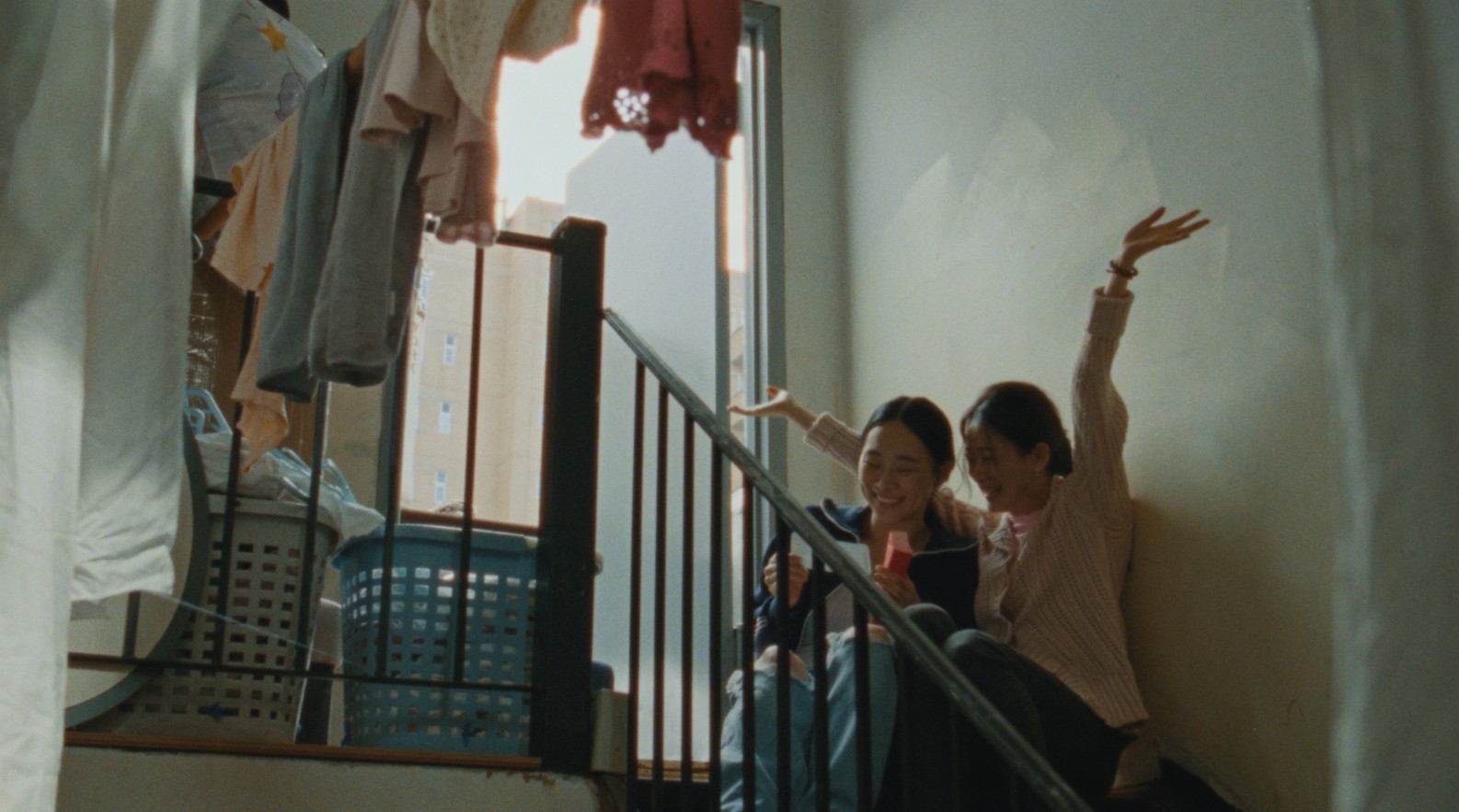
We’re far past the immigrant story in modern cinema. It’s a concept that’s been done to death but somehow continues to dazzle audiences. It’s not so much that these stories are bad or invalid, but they’ve become insular, the opposite of what they’re supposed to be. Many immigrant stories have become self-obsessed portraits meant for the layman to tongue bathe and virtue signal at. Things of inherent substance bastardized to capitalize on cheap pathos and lazy prose. That being said, every once in a while, someone is capable of readapting this tradition with something of greater significance.
What happens when you take an “In The Mood For Love”-esque plot and mix it with Tsai Ming Liang’s flavor of storytelling? Well, you get something like “Blue Sun Palace.” This is the directorial debut of Chinese-American director Constance Tsang, an artist who isn’t afraid to wear her influences on her sleeve.
Of course, the film does manage to become something more than its inspirations. It’s almost like a reimagining of antiquated film ideas repackaged through a modern lens. While that denotation may not sound flattering, it certainly is in this context.
Tsang’s interpretation of the intrepid immigrant story is crafted with extreme care. The secret is not to focus entirely on the concept of cultural adaptation. Rather, how those from different cultures assert themselves into a unique environment. How those things affect what are otherwise ordinary human experiences. The significance isn’t found within the experience itself, instead, it’s the aftermath of what comes later.
In its simplest terms, the film follows two protagonists navigating loss in an unfamiliar territory. The audience is brought into this experience through the rough pre- and post-structure that the film follows. One could even argue the movie doesn’t even start until a tragic loss occurs.
To portray someone grieving, you have to slow things down. You depict stillness as life. Tsang is exceptional at this, and the performances from our respective protagonists, Amy (Wu Ke-Xi) and Cheung (Lee Kang-sheng), complement each other well and fit the world she created.
Kang-sheng is most known for being a regular in the aforementioned Tsai Ming-Liang’s films. His performance fits this style of slow-burn cinema and punctuates how unfamiliar his character is with his surroundings. His actions are listless and melancholic but filled with an air of whimsy that is overwhelmingly compelling.
Despite technically being an American film, a majority of the film is in Mandarin Chinese. This further estranges the characters from their foreign living arrangements but also strengthens their bonds with each other. There’s something relatable about a person you can communicate with earnestly, and the film takes the time to highlight that obscure pleasure. In fact, there’s a lot of time dedicated to mundane pleasantries that make the world feel lived in and natural.
Despite ending on a poignant note, there’s a lot of simple joy within what is otherwise a tragic package. That’s ultimately what the film excels at, and it makes sense given modern circumstances.
In the present reality, many immigrants have come to terms with their new identity. They accept who they are and now live mundane, relatable lives. They’ve already carved out their little space in America. The real question is, what are they going to do with it?
 Turn off the Bright Lights