Whether one would like to believe it or not, the paths of cheerleading and filmmaking are intertwined. Although one could make the argument that cheerleading – in the sense of gathering together and screaming in support – has existed since the dawn of civilization, cheerleading as we know it today dates back only to the 19th century, the same century wherein the first undertakings of motion pictures took place. Thus, it would only be a matter of time before the “cheerleading movies” genre was born and subsequently evolved.
One could argue that the era of “cheerleading movies” in the United States has come and gone, with its height in popularity primarily in the late 1990s and early 2000s with films like “But I’m a Cheerleader” and “Bring It On.” However, with the 25th rendition of the San Diego Asian Film Festival, the Korean film “Victory” directed by Park Beom-su – which was stated to have been Korea’s first “cheerleading movie” – indicates that time is circular, and what was once a fad always has the opportunity to come back, and with just as much fervor.
Set in 1999 in the small shipbuilding town of Geoje, Korea, “Victory” tells three stories that intertwine throughout the movie. The first, and main storyline, follows Pil-sun (Lee Hye-ri), a high school girl with an attitude who aspires to become a dancer in the K-pop industry in Seoul, and her friend, another aspiring dancer who is always rocking a Baseball Hat, something that will be important later, Mi-na (Park Se-wan).
The film’s main subplot revolves around the football team of the main protagonists’ high school. Their American football equivalent would probably be Cleveland Browns i.e. they suck. However, all that changes when the football-obsessed principal of the school (Ju Jin-mo) manages to transfer football phenom Jin-tak (Cha Joo-wan) from a high school in Seoul over to Geoje. Alongside him comes his cheerleading sister Se-hyun (Jo A-ram).
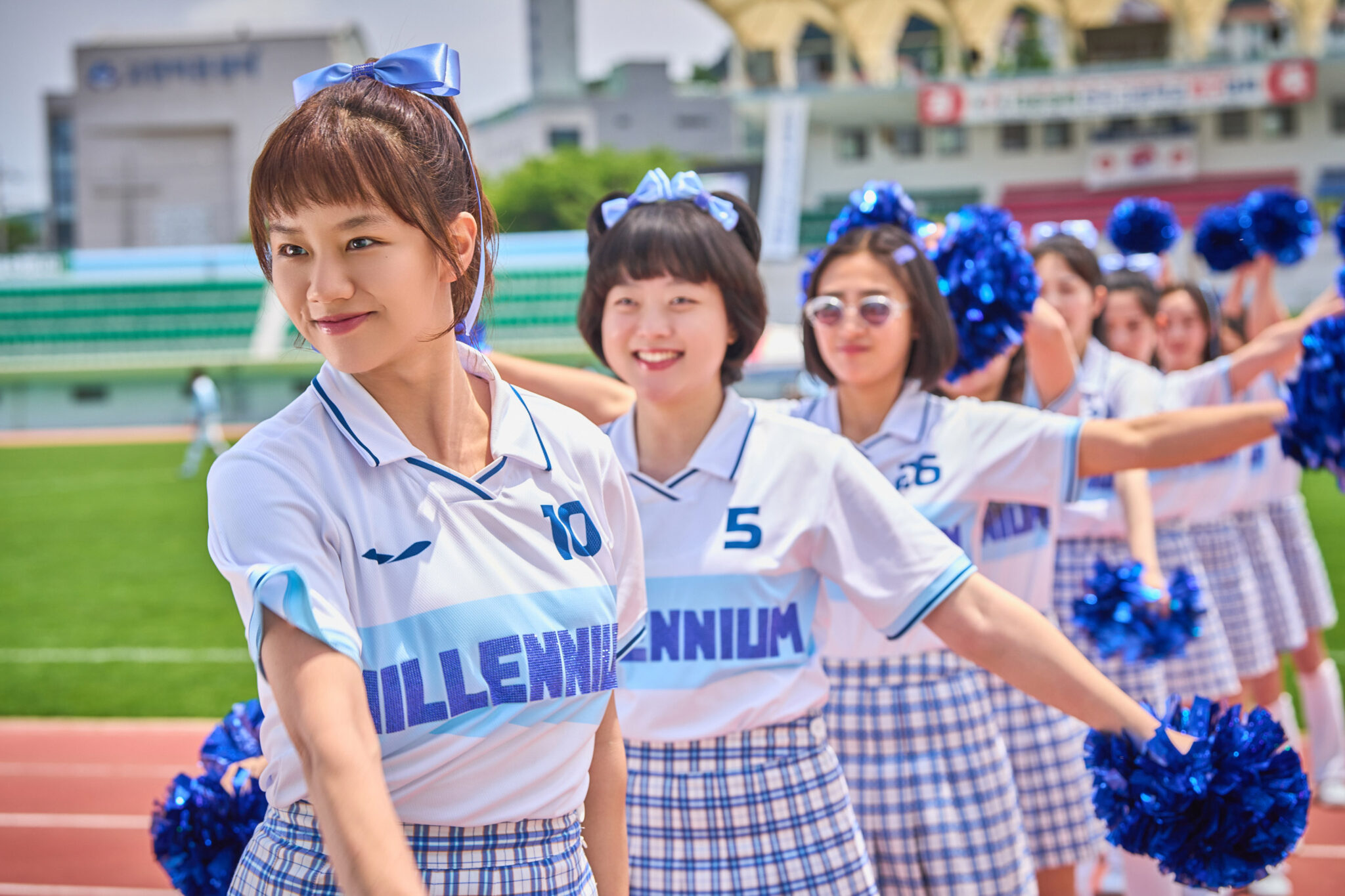
This is where these two storylines begin to intertwine, wanting a room to practice their hip-hop dancing, Pil-sun and Mi-na convince Se-hyun to trick the school into believing they are starting a cheerleading team to support the football team. They get their wish, and eventually, they form the ragtag group of cheerleading girls known as the Millennium Girls, commemorating the Y2K phenomenon of the time. Initially aren’t very good, but after an obligatory training montage, they become superstars, and the boys become champion contenders.
The film’s lightheartedness is where it shines most. From the cheerleading side, the dance choreography and cinematography were high energy, and the music choice of late 90s K-pop complemented each dance section in the movie. Additionally, the cheerleaders’ costume design was extremely creative. When the group first started, they used plain pink sweatshirts with the letter M stitched onto them, but as the group began to perform better, their outfits also got better, culminating in an outfit that mirrored the football team’s uniform, but with “millennium” in bold lettering across the chest along with a pair of matching white leg warmers. They looked like an actual team of professional cheerleaders.
More important than the outfits is the cheer squad themselves. It’s worth mentioning that each character does fit an admittedly generic archetype: the nerd, the tomboy who secretly knows taekwondo, the weird one, etc. However, none of the archetypes are too over the top or become annoying. All of the characters in the cheer squad are likable and display a clear chemistry between each other.
None of this is to shortchange the football side of the story either, for being a “cheerleading movie,” this was also a good football movie. They did not skimp out on the high-intensity athletic scenes, there were times that it felt like I was watching a football anime, with camera shots and angles that were almost inhuman. Each goal was satisfying, especially the play to win the team’s final game – a third-place game in a tournament – which was a flying sideways kick performed by, none other than, soccer phenom Jin-tak.
However, as all this plays out in the film, a third storyline takes place. Pil-sun’s father Woo-yong (Hyun Bong-sik) is the manager at one of the shipbuilding yards in the town. The viewer is cued into the fact that the working conditions of the shipyard are not good. They’re overworked, behind schedule and it’s to the point where people are beginning to get injured. As a result, the workers begin a labor strike that halts the production of ships. Woo-yong is caught in the middle, wanting to support his comrades while also wanting to appease the higher-ups.
Coincidentally enough, during the training montage, one of the venues where the Millenium Girls practiced their moves was the shipyard part of the labor strike. Fast-forward, to a scene that involves a fight between the protagonists and another school, it turns out that one of the injured students from the other school was the son of an important person from the company who operates the shipyard. This then causes Woo-yong to beg for forgiveness from the girls, this sight of her father leads Pil-sun to run off to Seoul – believing that her father does not have the strength to stand up against a tough world – to pursue her dancing career.
Before leaving, Mi-na and Pil-sun have a heart-to-heart, which ends with Mi-na giving Pil-sun a Padres hat as a parting gift, oddly fitting since the film festival takes place in San Diego. However, of course, Pil-sun eventually comes back, has an “I love you” moment with her dad, gets the gang back together right before the last game, and cue the happy ending with a major victory.
Despite the predictable ending, the two lighthearted storylines are the most enjoyable parts of the movie, but it’s the third storyline with the father and shipyard that could have been left out. This isn’t even mentioning a love triangle subplot that simply isn’t worth divulging. With all four of those moving parts, there was simply just too much going on in a movie that could have easily been streamlined into something more cohesive
Nonetheless, for Korea’s first attempt at a cheerleading movie it’s garnered some success – amassing $3,293,889 in its gross worldwide box office – it’s evident that Korea’s era of “cheerleading movies” is finally upon us and can improve from here on out.
 Turn off the Bright Lights