Of all the emerging trends of recent cinematic history, one of the least promising has to be the decline of media interpretabiliy.
While directors have always been open about sharing their work, never before has the “meaning” or “purpose” of something become such a heavily scrutinized point. Whereas some experimental auteurs of the past like David Lynch remove themselves from their personal interpretations, modern directors seem much more interested in sharing what they believe their stories are about, rather than allowing the audience to live inside of the world and come to their own conclusions.
This could be a side effect of multiple changes to the film industry. Press runs are much more prevalent to the average consumer and there are far more avenues to engage with a given piece of media. Creators also have a direct line of communication between themselves and their viewers through social media, subsequently disadvantaging artists who wish to remain more private. Given that this level of openness is relatively novel, it paints a gloomy picture of the future of what could be considered the new echelon of “experimental cinema.”
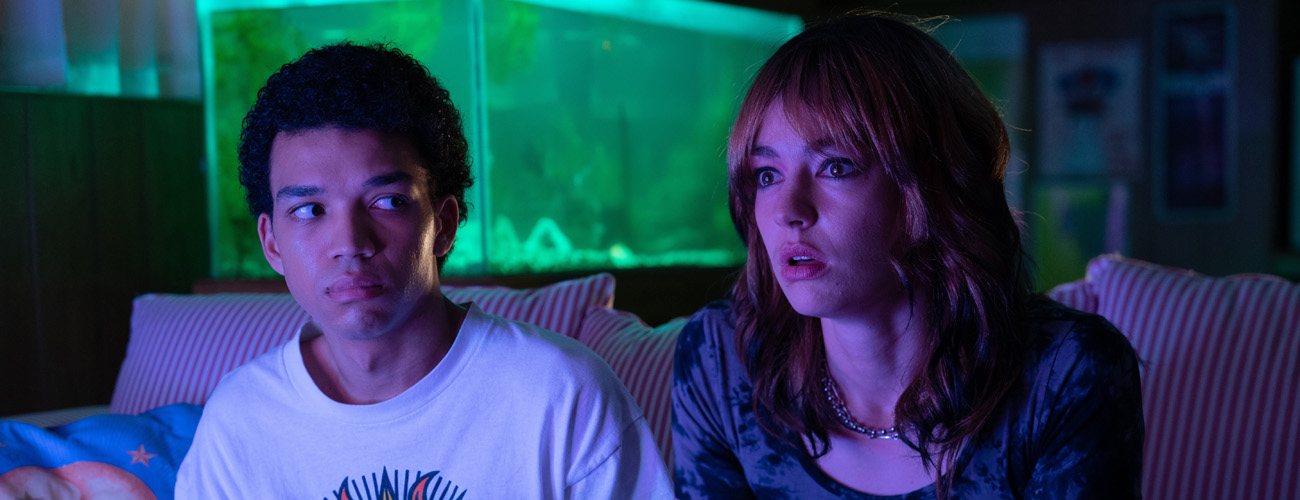
“I Saw The TV Glow” is the newest film from A24, an indie film company turned movie titan. Since its release, director Jane Schoenbrun, who identifies as nonbinary and trans, has been very open about what they believe the film is saying and what they hoped audiences would get out of it. While that doesn’t necessarily mean there is zero room for new analysis, when an unconventional and visually robust film such as “I Saw The TV Glow” releases with an already set-in-stone definition, one cannot help but feel a tinge of disappointment. It’s almost as if any other interpretation is invalid as a result of Shoenbrun’s candidness.
We’ve seen this scenario repeat itself almost beat for beat with the Matrix series of films. Co-director Lilly Wachowski revealed in a Netflix interview that the Matrix was meant to be a “trans allegory” but claimed the world wasn’t “ready for it.” She would later backtrack on these claims in a separate interview, saying that her response was misrepresented by Netflix, but by that point, her previous statements had already been broadcast by most popular media outlets. In contrast, Schoenbrun has been very clear on “I Saw The TV Glow” being a trans-coming-out story, and as of writing this, they haven’t stepped away from that interpretation whatsoever.
Ultimately, what we gain from both instances of directors sharing their opinions on their own movies is a lesson in perspective, more specifically, the effects that come from a single-point perspective. In the case of “I Saw The TV Glow,” it’s also the perfect case study on how an artist can be so incredibly wrong about their own work.
It’s only natural for a director like Schoenbrun to jump the shark as soon as they begin. It’s not a benign condition, it’s common for many auteurs who are entering the film sphere. “I Saw The TV Glow” just so happens to be a unique case due to its subject matter and immediacy.
For all intents and purposes, “I Saw The TV Glow” seems like a continuation of the same themes Schoenbrun developed in their second film “We’re All Going to The Worlds Fair.” They’re both tales of obsession, childhood nostalgia, and the darkness of growing up. Both films also intend to recontextualize teenage socialization, with each interaction between the main characters feeling uncomfortable and borderline cringe-worthy. This is all just to say, that the connective tissue between both films is very explicit.
That being said, “I Saw The TV Glow” takes things a step further. It very plainly lays itself out for the audience and follows a much more streamlined narrative. There are no playful intermissions or experimentation with media forms. Instead of the socially conscious internet-driven presentation, left in its place is an unmistakably modern take on a retro aesthetic that only exists in what we remember. One could call this intentional, as “I Saw The TV Glow” seeks to rewrite an already reminisced history, but in the same vein, there is a lot of deliberate effort put into the production design that says otherwise.
This is hardly a negative, and something that most nostalgia-latent films do partake in as well, but regardless it’s an important distinction to make clear before anything can be said about the not-so-hidden subtext of the film. The visuals are meant to say a lot about what our main character experiences and more or less determine the trajectory of the story. Time periods and the overall process of time itself play a very important role in developing our tragic protagonist, Owen (portrayed by Ian Foreman initially, then by Justice Smith), and seek to suspend our disbelief further.
For instance, parallels between Owens’s seventh-grade self and Owens’s ninth-grade self seem to reflect his lack of maturity. In a long tracking shot, both versions of Owen walk to his friend Maddy’s (Brigette Lundy-Paine) house with the same level of awkwardness and hesitation despite the two-year gap between both instances. In another scene, a seventh-grade Owen is shown lying in the back of his parent’s car, asking his mother’s permission to hang out with a friend. A scene later in the film, frames ninth-grade Owen in the same position, once again asking his parents permission, this time to stay up late.
This is a recurring theme throughout the film and haunts Owen even into adulthood. It’s implied this is due to an inherent fear Owen has of his own father, but it’s also worth pointing out that Owen responds to all forms of command and control, even from Maddy. Only twice does he make a decision for himself and both times it’s for fear of disappointing another commanding figure.
It seems more apparent that Owen simply respects the rules of seniority. Throughout the film, Owen is never really seen interacting with people his age, instead, he becomes a vessel for others to take advantage of. From this, it would appear his history of inaction seems to be more a side effect of his permissiveness rather than an intrinsic lack of autonomy. The fictional in-universe TV show Owen and Maddy obsess over “The Pink Opaque” highlights this character trait further.
“The Pink Opaque” is marketed as a TV show for young adults, immediately enticing Owen with the prospect of appearing older and therefore more mature, a very common desire for younger teens. Maddy’s status as a “young adult” adds to his disillusionment with his own age group and sense of self. Owen idolizes not only those seemingly superior to him but identifies himself with parts of them. This is precisely how he becomes engrossed and captured by the hands of the media.
Both Owen and Maddy seek solitude and escape in the fictional media they consume, allowing it to take hold of their lives and perceptions. Maddy, who is also a victim of media manipulation infects Owen with her own visions and preoccupations. It manages to reach a point where she becomes convinced they’re living the alternate lives of the main characters from the show, all set in place as an elaborate rouse by the fictional in-universe villain Mr. Melancholy. While Owen rebukes these claims telling Maddy, “It’s just the suburbs,” the damage done to his impressionable mind has already made its irreparable mark.
It should be stated that both characters appear to come from difficult home lives. Owen outside of his fear of his father also silently grieves the declining health of his mother and Maddy lives with an abusive stepfather. This essentially makes both characters the prime targets for media escapism, but what’s more harmful is the irreversible psychological damage that seems to come from both sides of abuse. They seek to insert themselves into the main characters because they possess traits and opportunities simply not present within their existence. However, this incidentally propels them further into a cyclical state of disillusionment with reality. Their method of coping is self-destructive and further estranges them from society and reaching their potential.
By the end, Owen is caught in an unfilling cycle of existence, surrounded by the childhood that eludes him. Memories of birthday parties and the old TV shows he used to enjoy fade into obscurity as he’s surrounded by an indifferent world. It’s not so much that the world he’s living in is miserable, it’s that he’s miserable living in it. It’s not like the mystical world shown in “The Pink Opaque.”
Shoenbrun interprets the ending as equally tragic but for a different reason. They see it as Owen refusing to accept his true self, the fact his real body is in “The Pink Opaque.” Even as Owen quite literally opens himself up, he rejoins the world apathetic to his plight. Owen is lying to himself and the audience. In the end, he is forced to live a passive life, conforming himself to the constraints world around him. It’s a rather literal interpretation, and for a film with such a unique style, it doesn’t present something very interesting nor does it extend past the walls of the story at hand.
What seems more likely is that the poignant ending acts as a cautionary warning. It’s a pointed reflection of the audience, a look into the lives of those who allow the media they consume to control their hollow existence. It’s what happens when we let the media we consume define us and cultivate our understanding of ourselves. It’s what happens when we refuse to open ourselves up, and accept reality as reality. We carry on living the delusions we keep inside our heads and expect the world to validate them simply because it’s how we feel.
Don’t watch the artificial TV glow, instead, let the sunshine in.
 Turn off the Bright Lights
One thought on “What ‘I Saw The TV Glow’ is Really About – Ending Explained”