One of the most common motherly hyperbolies we hear in early childhood is about how far they would go to protect us. Usually something along the lines of, “I would hurt anyone who tries to lay a finger on my baby.” While this statement is obviously not meant to be taken literally, it nonetheless instills a level of morbid security in our sacred youth. It makes you wonder the extent a parent would actually go to safeguard their child against the harms of the world.
Hur Jin-ho’s 2023 film, “A Normal Family” demonstrates what these lengths could theoretically look like and then some. It’s a Korean adaptation of a Dutch novel called “The Dinner,” which has already seen several adaptions beforehand from multiple countries. This one, out of all of them, seems to be the most positively received by audiences, a rather small feat considering its dull peers.
The film begins with a scene of road rage between two belligerent strangers: a father driving his daughter and a teen recklessly driving his Maserati around. The interaction results in the teen driving his car into the father, killing him, and also critically injuring the daughter. This event sets the film in motion as our main characters are loosely connected to this moment but it also demonstrates the most common motif seen in the film. The interconnectedness of family and how our actions and consequences often cause a ripple effect, condemning more than just ourselves.
Representing the driver in court is Jae-wan (Sol Kyung-gu), a shady defense attorney who uses the law as a cloak to disguise and manipulate reality to his liking. Brother to Jae-wan is Jae-gyu (Jang Dong-gun), a doctor working at the same hospital where the daughter from the start is receiving treatment after being crashed into.
Early on, Jae-gyu is posed as the de facto protagonist: he’s appalled by his brother’s complete apathy when Jae-wan asks him to ask the daughter’s mother to take a settlement deal, he works in a more respected profession, and, most importantly, he prides himself on his strong moral compass. Their main unifying factor stems from their shared experience of fatherhood, although they have very contrasting parenting styles that end up leading to the same place as the film goes on.
Jae-wan, father to Hye-yoon (Hong Ye-ji), becomes more distant from his eldest daughter as he rears a new child from a new wife, hoping that the lavish lifestyle that he provides will suffice his absence. On the other hand, Jae-gyu is a father to a son, whom he’s extremely firm with. Jae-gyu wants his son to build his own path, rather than taking any handouts from him. The only real similarity between both of them is their high regard for education. An unremarkable footnote, given the near-universal importance of education in Korean culture.
By and large, a child is the reflection of the parent’s values and teachings. They’re placed in particular environments that present decisions to that child, the consequences of those decisions then shaping the child into an adult. It’s an endless cycle of regression and progression, and a parent can only hope that their child will do the right thing. “A Normal Family” highlights this fact of life constantly, especially after the main conflict of the film reveals itself.
The parents’ respective children end up putting a homeless man in critical condition while they are away at dinner, thus, presenting a caution – despite a parent’s best efforts, their children still select their own path. It can be argued this moment in the film is identical to the first conflict shown at the beginning. An act of violence causes a ripple effect that reflects not only on themselves but on the rest of their family. An all too obvious parallelism that ultimately doesn’t reveal much more than it did initially.
As expected, Jae-wan attempts to slide things under the rug, while Jae-gyu at one point attempts to turn in his own son to the police. However, as more information is revealed about the circumstances of that night, and the death of the homeless man comes to pass, the roles between the fathers begin to shift.
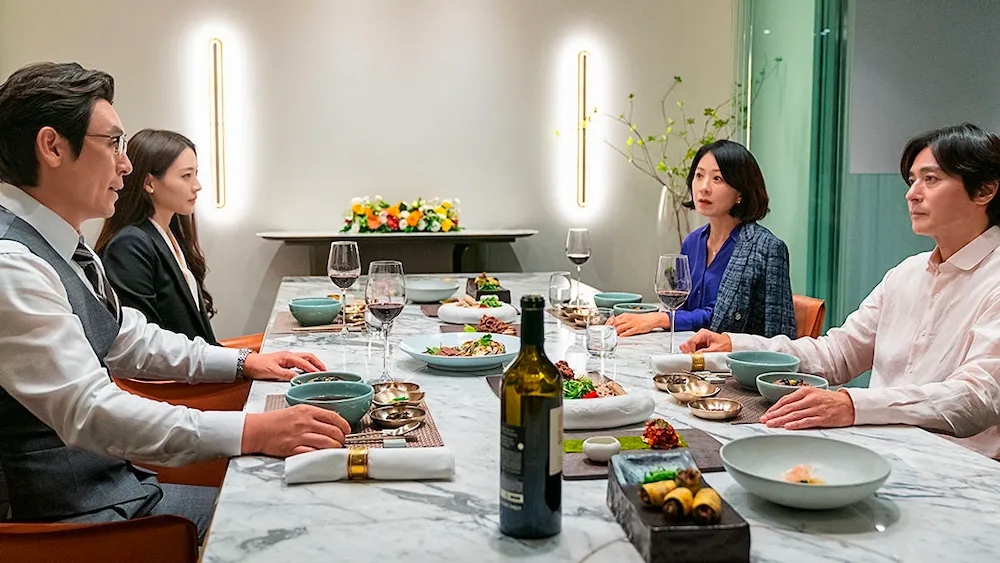
However, this shift is where the film begins to falter. Although the movie highlights this internal conflict of moral compasses and the cognitive dissonances that tend to take over once one’s children are involved, the reasonings behind the shifts in opinion are contrived. Furthermore, the poor execution is highlighted by an underwhelming climax in which the families argue in a poorly directed dinner sequence.
On one hand, it can be said that Jae-gyu switches not only because his moral compass falters because of his love for his son, but because he simply wants to surpass his brother, wanting to be contrary to him. This stands perpendicular to the film’s theme Jae-wan says at the beginning, “Everybody gets weak before their children.” Rather, Jae-gyu becomes weak before his brother.
On the other hand, Jae-wan, originally set on allowing his daughter to get away with murder, suddenly has a change of heart when he discovers that the children actually don’t feel any remorse for their actions. This scene has no emotional weight to it as it is plainly obvious that Jae-wan’s daughter does not care. Multiple times throughout the film she expresses clear apathy towards being an accomplice to the murder.
As a brief aside, I am currently attending law school and thought it’s interesting that it never once crossed Jae-wan’s mind that he is now an accessory after the fact as he intentionally helped her evade arrest, knowing that she committed a felony.
I digress. While Jae-gyu’s switch is offensive on a thematic level, this switch is offensive on a storytelling level as it completely telegraphed what is going to happen in the penultimate dinner scene where Jae-wan expresses that he must uphold the law, while Jae-gyu sees it as his duty to protect the integrity of his son. Effectively, the dinner scene renders the surprise ending scene, as lackluster shock at best.
Although the film possesses an interesting premise, it sputters in the finer details about presenting the central conflict, resorting to an obvious shock ending that unfortunately is not enough to leave a lasting impression about parenting or family life.
Fabian Garcia contributed to this post.
 Turn off the Bright Lights